Chapter 1 – Series Context
Episode 2 of the same 7-part roadmap we wish we’d had when we began. 7 deadly sins for your business .
Make sure you read the whole series and implement aggressively, then ping us with questions.
Start with the master post → https://ecomhackers.ai/2025/05/11/the-7-silent-killers-that-stall-e-commerce-brands-between-500k-10m/
Library of all episodes → https://ecomhackers.ai/articles/
Dive into Scale-Killer #2—A faltering repeat-purchase engine and how to reignite it.
Chapter 2 – INTRO
What if your business is leaking 85% of customers after their first purchase?
What if the true cost of growth is not just the CAC you pay today, but the customers you never invite back tomorrow?
Chapter 3 – Why This Matters Now
On 25 May 2025 the median repeat-purchase rate in e-commerce still drifts between 15 % and 30 % . Brands roar about acquisition hacks while the quiet leak widens: every unsatisfied first-time buyer becomes an unpaid detractor. In an era where attention inflates faster than freight, the unseen loop, the second, third, fourth order decides who survives the auction.
We MUST focus on this !
Chapter 4 – What You’ll Learn
This isn’t another “10 retention hacks” list. You’ll uncover why time-to-second-order is the pulse of your business, how to engineer “habit loops” into your customer journey, and why bundling products like a sommelier pairs wine reshapes profitability.
Chapter 5 – Who This Is For
Founders who’ve felt the dissonance of pouring money into ads only to watch revenue flatline. Marketers tired of chasing trends. Leaders ready to trade vanity metrics for velocity.
Chapter 6 – A Contrarian Lens on Loyalty
Conventional wisdom: “Growth is forward motion with more SKUs, more channels, more campaigns.”
The contrarian: Growth is a spiral; velocity lives in returning circles, not linear paths.
Loyalty isn’t earned—it’s engineered.
Imagine your business as a heart. First-time buyers are the first beat, VITAL, but meaningless without rhythm. Without retention, you’re in cardiac arrest, pumping blood (cash) into a body that can’t circulate it.
What if customers want to return, but your systems nudge them toward amnesia? The fix isn’t discounts—it’s dopamine. Design experiences so satisfying that buyers fall back into your orbit voluntarily.
Chapter 6.1 – Questions to Ask Yourself
When was the last time you measured the silence between order #1 and order #2? Silence, too, speaks.
When did you last fall in love with a brand? Was it the product or the way it made you feel seen?
Chapter 7 – Data, Research & Expert Insights
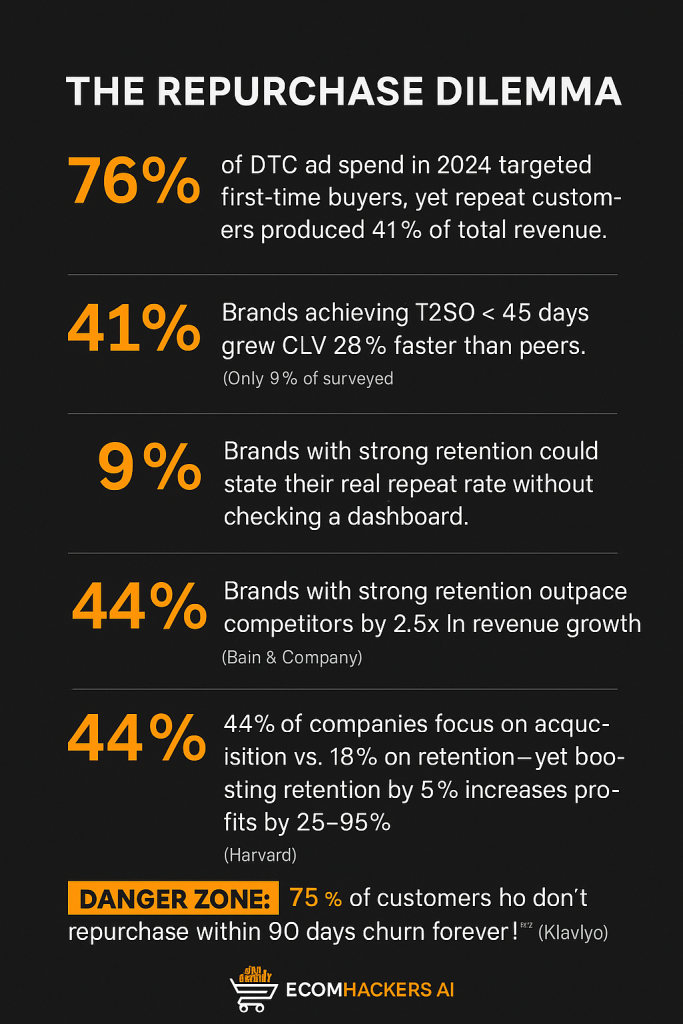
- A 2023 fMRI study revealed that repeat purchases activate the brain’s habit formation circuits, not rational decision-making. Loyalty is subconscious.
- MIT’s “Nudge Theory” proves that subtle reminders (e.g., milestone emails) boost repurchase rates by 19%.
- Harvard Business Review (2022): SMS nudges at day 30 cut churn in subscription commerce by –11 %.
Loyalty is a math problem. Map the ‘emotional delta’ between first and second purchase.” —Clara Hughes, Retention Architect
Chapter 8 – Real-World Examples & Case Studies
8.1 Success Story
Cookware brand lifts repeat revenue via post-purchase segmentation
HexClad generated +$800 K from new & repeat buyers by layering postcard win-backs on top of email/SMS flows.
8.2 Failure Story
Fashion/DTC brand implodes after retention neglect & high returns
https://fortune.com/2024/03/26/outdoor-voices-bankruptcy-closure-layoffs-ashley-merrill
Outdoor Voices announced it would close all physical stores (March 2024) and pivot online after years of margin pressure and stalled repeat sales.
Chapter 9 – Common Mistakes & Myths to Debunk
9.1 Myths
- Myth: “Our product sells itself.” Reality: Even Apple uses upgrade nudges and trade-in reminders.
- Myth: “Loyalty programs are enough.” Reality: Points without emotional hooks become accounting exercises.
- “If customers love the product, they’ll come back.”
Love needs reminders; memory decays in seven days. - Baseline myth: “Repeat rate is fine—I see many returning names.”
Anecdote is not a metric. Pull the data or fly blind.
9.2 What NOT to Do
- Don’t stalk customers with daily emails. Instead, time triggers to their usage cycle (e.g., “Your serum runs out in 7 days”).
- Don’t default to discounts. Offer exclusivity (“Early access for our top 100 customers”) or utility (free masterclasses).
Chapter 10 – Actionable Takeaways & Step-by-Step Guide
Build this six-stage retention engine :
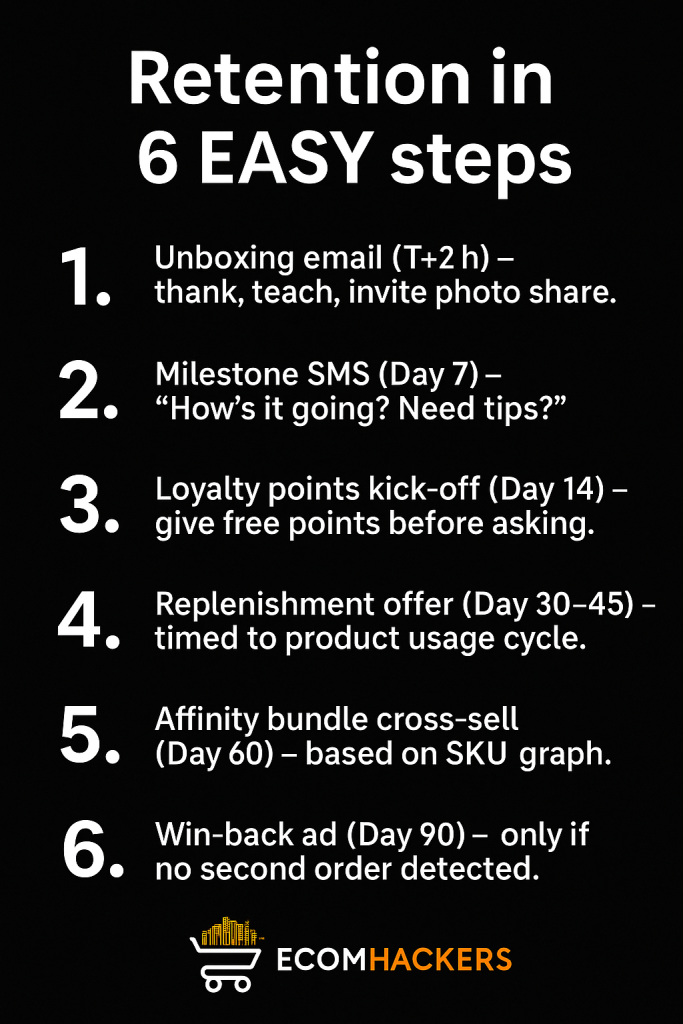
10.1 Simple Actions You Can Add
- Run a SKU affinity analysis (tools like Northbeam or Littledata) to find product pairs.
- Bundle low-cost + high-margin items (e.g., 20phonecase + 20 phonecase + 5 screen cleaners = $22 bundle).
You’re not building a highway of new cars—you’re designing a roundabout. Traffic that exits must find the circle inviting enough to re-enter.
Chapter 11 – Psychological Triggers to Use
11.1 Urgency
Urgency exploits the Zeigarnik Effect—the brain’s obsession with incomplete tasks.
- Your cart expires in 1 hour
- Your 14-day skincare peak ends tomorrow
- Points expire in 14 days.
Data: Time-limited offers boost conversions by 27% (Nielsen).
Mistake: Overuse erodes trust.
Fix: Use urgency only when tied to real value (e.g., seasonal relevance).
11.2 Scarcity
Scarcity triggers loss aversion (Kahneman, 2011). Losing access hurts 2x more than gaining it.
Examples :
- Only 7 bundles left
- Restocking in 2026
- First 100 redemptions unlock a bonus utensil.
Supreme: Drops sell out in minutes because scarcity is baked into their DNA, not just marketing.
11.3 FOMO
Self-discrepancy theory (Higgins, 1987) – we act to align our “actual self” with our “ideal self.”
Examples :
- The old you tolerates dull skin. The new you? She’s booked a spa day.
- Join the 23% who’ve upgraded their morning routine
- Showcase UGC of others using bundle #2; invite belonging.
11.4 Reciprocity
Cialdini’s reciprocity principle—we feel obligated to return favors.
Examples :
- Free samples: Sephora’s birthday gifts drive 4x higher redemption rates
- Unexpected generosity: “We added a free linen spray—your couch will thank you.”
Data: 70% of customers feel compelled to reciprocate after a gift (Journal of Marketing).
Mistake: Giving with strings attached. Fix: Make the gift genuine (no purchase required).
Costco: Free food samples = $15M/week in incremental sales (CNBC). Reciprocity is tastier than ads.
Chapter 12 – Final Thought
Repeat buyers aren’t metrics, they’re relationships.
Treat them like a first date that never ends.
12.1 Ask Yourself
When did your brand last surprise a customer? Could that moment have been automated?
When did you last measure your store’s silence?
Chapter 13 – Immediate Next Steps
- Choose one of the six flows and launch it within 24 hours
- Audit your last 100 customers: What % bought again?
- Install a “90-day rescue” SMS flow for at-risk buyers.
- Reply to this article with your biggest retention roadblock and we’ll crowdsource solutions.